

Most families enter retirement without answers to the four decisions that matter most: when to claim Social Security, how to make savings last 25 years, whether a reverse mortgage makes sense, and how to cover healthcare costs that most people never see coming. This guide covers all of it in plain English.
Last updated: September 2026
Why Financial Planning for Retirement Looks Different
Effective financial planning for retirement is not a continuation of what you did while working. The rules change in ways that catch most families off guard. You shift from accumulating money to drawing it down. Your income sources change: instead of a paycheck, you are managing Social Security, pensions, and withdrawals from retirement accounts. Your biggest financial risks shift too. Inflation, healthcare costs, and the possibility of outliving your savings become the central concerns.
The decisions you make in the first few years of retirement are the ones that lock in your options for the decades ahead: when to claim Social Security, how to sequence withdrawals, whether to stay in your home or downsize. Getting them right does not require being a financial expert. Getting them wrong does not require making bad investments. It often just requires not knowing a few things at the right time.
This guide covers the core financial planning for retirement topics that seniors and their families most frequently need to understand, with plain-English explanations and links to more detailed guides where available.
Estimated healthcare costs in retirement for a 65-year-old couple (Fidelity 2025)
Maximum monthly Social Security benefit in 2026 for someone who waits until age 70 (SSA)
Share of Americans who say Social Security will be a major source of their retirement income (Allianz Life, 2025)
How Much Money Do You Need to Retire?
This is the question most people arrive at retirement without a clear answer to. The answer depends on your monthly expenses, your Social Security benefit, and how long you live. But there are two widely used frameworks that give you a starting point.
The 4% Rule
Financial researcher William Bengen found in 1994, later confirmed by what became known as the Trinity Study, that a retiree withdrawing 4% of a balanced portfolio annually had a very high probability of not running out of money over a 30-year retirement. The rule has been debated and revised over the years. Many financial planners now suggest 3 to 3.5% is more conservative given today’s market conditions and longer life expectancies. But as a starting framework, 4% remains the most widely cited benchmark.
In dollar terms: a $500,000 portfolio generates $20,000 per year at 4% withdrawal. A $1 million portfolio generates $40,000 per year. Add your expected Social Security benefit to estimate your total annual retirement income.
The $1,000-a-Month Rule
Many financial planners use a simpler rule of thumb: for every $1,000 per month of retirement income you want beyond Social Security, you need approximately $240,000 to $300,000 saved. At a 4% withdrawal rate, $300,000 generates $1,000 per month. At a slightly higher 5% rate, $240,000 produces the same amount.
If you want $3,000 per month from your savings on top of Social Security, you are looking at roughly $720,000 to $900,000 in savings. If you are below that threshold, the strategies in this guide (Social Security timing, reverse mortgage, income sequencing) are the levers that change the math.
Is $600,000 Enough to Retire?
At a 4% withdrawal rate, $600,000 generates $24,000 per year from savings, or about $2,000 per month. Add the average Social Security retirement benefit of approximately $2,081 per month (as of April 2026, per Kiplinger) and your total monthly income is roughly $4,081. Whether that is enough depends entirely on your monthly expenses. $600,000 is workable, but tight, and it depends heavily on when you claimed Social Security and how well you manage healthcare costs.
Social Security: When to Claim and Why It Matters
Social Security is the foundation of retirement income for most Americans, and the timing of when you claim it is one of the most consequential financial decisions you will make. Claim too early and you permanently lock in a reduced benefit. Wait past your full retirement age, all the way to 70, and your benefit grows by as much as 24%. The right answer depends on your health, your other income sources, and your household situation.
For the full breakdown of the three key claiming ages, the break-even math, and the signs that point toward waiting (or claiming early), read our complete guide: Should You Delay Social Security Benefits?
Claiming age is not the only Social Security decision that affects your finances. Part of your benefit can also be taxable depending on your income. For the full breakdown of the thresholds and the new senior deduction, see Is Social Security Taxable?
If you’re married, or divorced after a long marriage, a spousal benefit may add to your household income too. For who qualifies, how much you could get, and how it interacts with your own benefit, see Social Security Spousal Benefits
Reverse Mortgages: What They Are and When They Make Sense
A reverse mortgage allows homeowners age 62 or older to convert a portion of their home equity into cash without selling the home or making monthly mortgage payments. The loan is repaid when the borrower moves out, sells the home, or passes away. For seniors who are equity-rich but cash-poor, a reverse mortgage can meaningfully change what retirement looks like.
For a complete explanation of how reverse mortgages work, the types available, the pros and cons, and what questions to ask a lender, read our detailed guide: How Does a Reverse Mortgage Work
A reverse mortgage tends to work best for homeowners who plan to stay in the home long-term and have significant equity to draw on. It tends to make less sense if you plan to move within a few years, want to leave the home to your heirs, or are already struggling to keep up with property taxes and insurance. The full breakdown of who it fits and who it doesn’t is in the guide linked above.
Building a Retirement Income Plan
Most retirees draw income from multiple sources. Understanding how each source works and how they interact is the foundation of a sound retirement income plan.
Social Security
Inflation-adjusted monthly income for life. Timing your claim is one of your most important decisions. See the Social Security section above.
Pension or Defined Benefit Plan
Guaranteed monthly income from a former employer. If you have one, understand whether it offers survivor benefits for a spouse and how it is taxed.
401(k) and IRA Withdrawals
Tax-deferred accounts require Required Minimum Distributions (RMDs) starting at age 73. Poorly sequenced withdrawals can significantly increase your tax burden.
Roth IRA
Tax-free withdrawals in retirement with no RMDs. If you have a Roth, it is typically the last account you draw from. Let it grow as long as possible.
Home Equity
For many retirees, home equity is their largest asset. Options include downsizing, a reverse mortgage, or a home equity line of credit.
Part-Time Work or Consulting
Earned income in early retirement can delay Social Security and retirement account withdrawals. For healthy, recently retired seniors, this is often the best financial move available.
The Withdrawal Sequence Problem
The order in which you draw from your accounts matters almost as much as the amounts. A common approach: draw from taxable accounts first, then tax-deferred accounts (401(k), traditional IRA), and leave Roth accounts for last. This sequence tends to minimize your lifetime tax burden. However, the right answer depends on your specific tax situation. A financial planner can model this for you.
Required Minimum Distributions
The IRS requires you to begin taking distributions from traditional IRAs and 401(k)s starting at age 73, as established under the SECURE 2.0 Act passed in 2022. The amount is calculated based on your account balance and your life expectancy from IRS tables. Missing an RMD triggers a significant penalty. If you have multiple accounts, consult a financial advisor to coordinate your RMD strategy.
Planning for Healthcare Costs in Retirement
Healthcare is consistently the expense that surprises retirees the most. Fidelity’s 2025 Retiree Health Care Cost Estimate puts the figure for a 65-year-old couple at $345,000, and that does not include long-term care. Most families who have not explicitly planned for this find out the hard way that it is the single biggest threat to a retirement income plan.
Medicare: The Foundation
Medicare becomes available at age 65 and covers hospital care (Part A), medical services (Part B), and prescription drugs (Part D). It does not cover everything. Dental, vision, hearing, and most long-term care are generally not covered. For a complete plain-English breakdown of Medicare and how to choose the right supplement plan, see our Medicare Parts Explained.
Long-Term Care: The Biggest Gap
Medicare does not pay for custodial care, the help with daily activities like bathing, dressing, and eating that most people associate with nursing homes or assisted living. This is one of the most significant financial risks in retirement. Options for covering long-term care costs include:
- Long-term care insurance: best purchased in your mid-50s to early 60s, before health issues make you uninsurable or premiums unaffordable
- Hybrid life and LTC policies: life insurance with a long-term care rider; if you never need care, a death benefit remains for your heirs
- Self-insuring: maintaining a dedicated savings reserve for care costs; realistic only for those with substantial assets
- Medicaid: covers long-term care for those who qualify financially; requires careful planning well in advance
Protecting Your Retirement Savings
Inflation
A retirement that lasts 25 years will see prices roughly double if inflation averages just 3% annually. A fixed income that felt comfortable at 65 may feel tight at 80. Social Security provides some inflation protection through annual Cost of Living Adjustments, but most other fixed income sources do not. Maintaining some growth-oriented investments in retirement, not just bonds and cash, is generally necessary to keep pace with inflation over a long retirement.
Sequence of Returns Risk
Poor investment returns early in retirement, when you are actively withdrawing funds, do more damage than the same losses later. A significant market decline in your first few years of retirement can permanently impair a portfolio, even if markets recover. Strategies like maintaining a cash buffer, a bucket approach to retirement income, or delaying Social Security to reduce early withdrawal needs can help manage this risk. For a full breakdown of what to do before and during a downturn, see our guide on how to protect your 401k from a market crash.
Financial Elder Abuse and Scams
Seniors are the primary target of financial scams: Medicare fraud, grandparent scams, romance scams, fake investment schemes, and more. Establishing trusted contacts on financial accounts (a family member who will be notified of unusual activity), working only with registered advisors, and having a consistent person reviewing financial statements are practical protections.
Your Financial Planning for Retirement Checklist
Use this checklist to identify gaps in your financial planning for retirement. One unchecked item does not mean you are behind. It is a starting point.
- Social Security claiming strategy analyzed: optimal age determined for your specific situation
- Retirement income sources identified: Social Security, pension, 401(k) and IRA, Roth, home equity
- Withdrawal sequence planned: taxable accounts first, then tax-deferred, Roth last
- RMD start date confirmed: age 73 under current law; strategy in place
- Medicare enrollment planned: timing confirmed to avoid late enrollment penalties
- Medicare supplement plan selected: Medigap or Medicare Advantage evaluated
- Long-term care plan in place: insurance, hybrid policy, or self-insuring strategy
- Monthly budget built for retirement: income vs. expected expenses mapped out
- Inflation protection in place: portfolio has some growth-oriented component
- Estate planning documents current: will, trust, power of attorney, healthcare directive
- Beneficiary designations reviewed: all accounts and policies updated
- Financial elder abuse protections in place: trusted contact designated on accounts
Picture yourself at 80, running through this list and checking every box. That is what good financial planning for retirement produces: not just a number on a spreadsheet, but the freedom to stop second-guessing whether you handled the early decisions correctly.
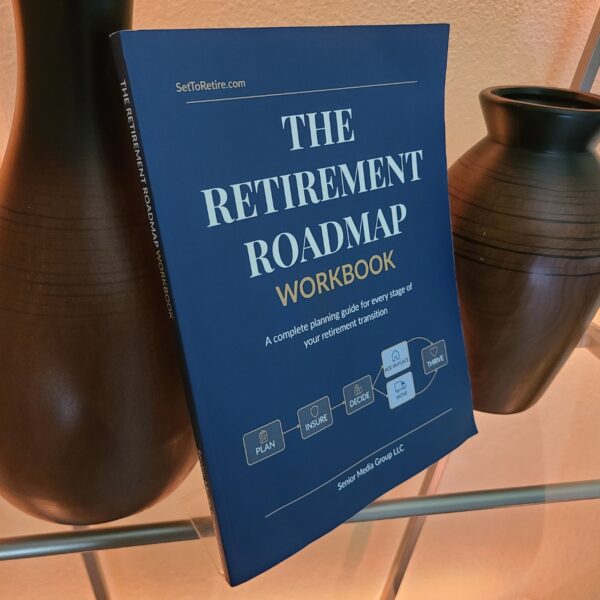
Turn This Checklist Into Worksheets
The Retirement Roadmap Workbook has a full Plan section built around these exact decisions: a financial inventory worksheet, a net worth snapshot, a Social Security timing worksheet, and space to track your RMD numbers all in one place before you sit down with anyone.
See the Workbook → $47 · 138 pages · softcover
Frequently Asked Questions
What is a good financial plan for retirement?
Solid financial planning for retirement covers five things: a Social Security claiming strategy based on your health and life expectancy, a retirement income plan that sequences withdrawals to minimize taxes, a healthcare cost plan that accounts for both Medicare gaps and potential long-term care costs, inflation protection in your portfolio, and an estate plan with current beneficiary designations. Most families focus on the savings number and skip the strategy layer. The strategy layer is where the money is.
Does Medicare cover assisted living?
No. Medicare does not cover custodial long-term care, the type of ongoing daily assistance provided in most assisted living facilities and nursing homes. Medicare may cover a short-term skilled nursing facility stay following a qualifying hospital admission, but ongoing assisted living costs are paid out of pocket, through long-term care insurance, or through Medicaid for those who qualify. This is one of the most expensive gaps in retirement planning and one of the most frequently misunderstood.
What happens to my retirement accounts when I die?
Retirement accounts, 401(k)s and IRAs, pass to the beneficiaries you have named on the account, regardless of what your will says. This makes keeping beneficiary designations current absolutely critical. Named beneficiaries receive the account directly, typically subject to distribution rules based on their relationship to the deceased. Spouses have more flexibility. Non-spouse beneficiaries are generally required to deplete inherited accounts within 10 years under current law as established by the SECURE Act.
Continue Reading: Financial Planning Guides
- How Does a Reverse Mortgage Work
- Should You Delay Social Security Benefits?
- Required Minimum Distribution Rules
- Inherited IRA RMD Rules
- How to Protect My 401k From a Market Crash
- Is Social Security Taxable?
- Social Security Spousal Benefits
- Social Security Scams
- Railroad Retirement vs. Social Security
- Gray Divorce
- Reverse Mortgage Scams
Content on SetToRetire.com is researched and drafted with AI assistance, then reviewed and edited for accuracy by the editorial team at Senior Media Group LLC. It is provided for general informational purposes only and does not constitute medical, legal, or financial advice. Consult a qualified financial or tax professional before making decisions. For more on how we create content, see our Editorial Process.